Before the Feed: The Small Magazine and Its Particular Audience
See how a small magazine can give readers a shared reference point, and decide whether an edited publication suits an emerging cultural conversation.
The common mistake is to treat a small magazine as a miniature mass-market publication. That can obscure its practical value: a focused magazine gives interested readers a shared place to encounter, question, and preserve ideas. Its purpose is not necessarily to reach everyone, but to make a conversation easier to recognize and follow.
A subject takes shape
A small magazine can be organized around a defined subject, such as experimental poetry, local architecture, independent film, or a music scene. “Small” may describe limited circulation, but editorial focus is what distinguishes the publication. Readers arrive knowing that the subject has been selected deliberately, rather than placed among unrelated stories.
That focus affects what editors can publish. An essay can introduce unfamiliar terms, leave room for disagreement, or connect a local concern to a wider cultural question. The magazine can build shared knowledge over successive issues instead of explaining every reference for a general audience each time.
A printed issue also gives the conversation a material form. A reader can keep it, pass it along, or encounter it in a bookshop, library, club, or campus common room. A digital edition can serve as a shared reference as well. Neither format makes an audience visible automatically; that depends on readers finding and discussing the work.
Choosing a publication form
A magazine is not automatically better than a newsletter, forum, or public event. The useful question is whether readers need an edited sequence of contributions that can be revisited, or whether they need another kind of exchange.
- Consider a small magazine if the subject has several angles that benefit from appearing together. If readers need a lasting, edited collection, plan an issue; if they mainly need quick updates, consider a newsletter instead.
- Consider a newsletter if the main need is a regular note to an identifiable group. If readers want brief, timely messages, use that format; if they need substantial pieces arranged together, consider a magazine.
- Consider a discussion forum if readers need to respond to one another directly. If ongoing exchange is central, choose a forum; if readers need a coherent selection and sequence, use editorial publication.
- Consider a gathering if the subject depends on shared presence, demonstration, or local relationships. If participants need to meet and talk in person, arrange an event; if the work should remain available afterward, consider publishing a record too.
- Consider a broad publication if reaching people beyond a committed circle is the priority. If the subject already has a large potential readership, pitch a wider outlet; if the conversation needs room to develop among interested readers, a focused publication may fit better.
These forms can overlap, but they ask different things of readers. A magazine asks them to follow an edited sequence; a forum invites response; a gathering puts discussion in a particular place and time. Choose according to the audience’s need, not the novelty of the format.
When does a small magazine fit?
Can a magazine serve an obscure subject?
It can, if writers and readers share enough curiosity to sustain a conversation. Editors can make the subject legible through recurring coverage and clear introductions without claiming that a broad audience already exists.
How should editors handle disagreement?
Disagreement can give a publication substance when contributors address a shared question. Editors can place distinct arguments beside one another, explain their points of contact, and avoid demanding consensus.
Can a magazine connect readers in different places?
Print and digital editions can give dispersed readers a common text to discuss. The fit depends on whether the work carries enough context for readers to understand it outside its original setting.
What if the subject changes quickly?
A magazine may be a poor fit when readers need immediate updates or rapid back-and-forth. A newsletter, forum, or event can meet that need, while a later issue can preserve a considered account of the discussion.
Focus and belonging
An audience is more than a demographic category. It can be a group of readers who share enough interest, vocabulary, or experience to recognize why a subject deserves attention. Editorial choices help shape that group: which voices appear, what context is supplied, and which questions return.
For instance, a publication about neighborhood design might place residents’ accounts beside architectural criticism. That pairing makes lived experience part of the discussion, rather than treating professional expertise as the only relevant perspective. Editors are not neutral containers; their choices help define what counts and who can speak with authority.
Focus can also exclude people. If a magazine assumes too much prior knowledge, an invitation can start to feel like a test. Editors can preserve depth while making entry points visible: define a necessary term, identify the disagreement, or include a piece that welcomes readers who are new to the subject.
From circulation to culture
A small magazine can give writers room to try language, arguments, and forms that may not fit a broader outlet. Readers might carry ideas into conversations, organizations, classrooms, or later publications. That path is indirect: a magazine offers a place for development, not a promise that its ideas will spread widely.
An archive can help later readers encounter a conversation in its original context. Saved issues, letters, and related publications may show which questions were raised, contested, or set aside. Keeping those materials organized makes the publication’s record easier to revisit.
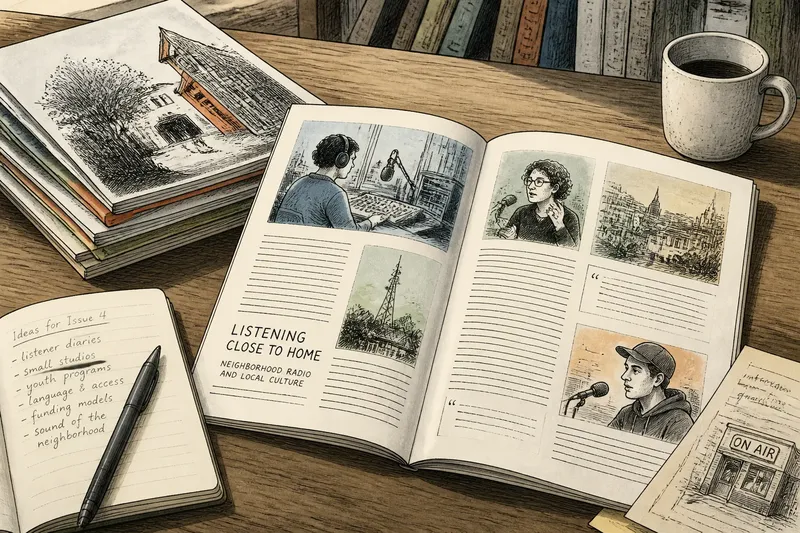
Say a group of readers wants to discuss independent neighborhood radio, but the subject appears in scattered reviews and event notices. They choose a digital magazine, ask contributors for station interviews, essays about listening habits, and accounts of local programming, then edit those pieces around a shared question: how does neighborhood radio connect listeners to local culture? The resulting issue gives the group one coherent reference point. It does not establish that the whole city shares the interest, but it makes the group’s discussion easier to continue and share.
It is not worth the effort to imitate a large magazine’s broad mix of topics just to look established. A narrow publication gains clarity by explaining what belongs and why. A striking cover cannot make unrelated contributions feel like a conversation.
Editorial decisions
Before starting, editors can use these checks to decide what the publication should do:
- Name the shared interest. Check whether the subject can be stated in language an interested reader would recognize. If it can, use that wording; if it remains abstract, rewrite it around a concrete question.
- Identify the intended reader. Check what that reader is likely to know and which voices are missing. If a clear gap appears, seek the missing perspective; if the audience is still too broad to guide choices, narrow the intended readership.
- Set an editorial boundary. Check whether each adjacent topic illuminates the main subject. If it does, explain the connection in the assignment; if not, leave it out or reserve it for another publication.
- Choose a rhythm and format. Check how quickly the subject changes and how much context each contribution needs. If the material needs room and permanence, plan an issue; if readers need brief, timely updates, choose a newsletter.
- Plan for disagreement. Check whether different positions address a common question. If they do, edit them into a useful exchange; if they do not, clarify the question or publish them as separate subjects.
- Decide what should endure. Check which pieces will remain useful after the immediate discussion. If they need a lasting record, preserve them in an accessible archive; if they are time-sensitive notices, keep them in a format suited to updates.
These choices distinguish an edited conversation from a collection of unrelated contributions. They also keep the intended readers in view: not an imagined mass audience, but people who can use this particular discussion.
A particular audience
A small magazine suits a subject that benefits from concentration, continuity, and a place where readers can return to shared ideas. If the main need is speed, direct exchange, or broad reach, another form may serve better. The small magazine’s contribution is the structure it gives a conversation—not a claim that every modest circle will become a larger movement.
For anyone considering a small magazine, the practical question is whether the intended readers have a reason to return and whether each issue gives them a clearer way to understand the subject they share. That is a sounder starting point than trying to appear large before the conversation has found its shape.