How to Read a Public Conversation Before Taking a Side
Read a public conversation before taking a side: map its participants, track how a message changes as it spreads, and see what still needs an answer.
The common mistake in reading a public conversation is to treat its loudest reaction as the whole story. That shortcut can obscure how a message traveled, whose voices shaped it, and what changed as it reached new audiences. To read a public conversation before taking a side, follow its path through the people and spaces carrying it.
Trace the conversation
Start with the original post, announcement, speech, or document, then note where the conversation moved. A comment thread, a local meeting, and a news report are different settings: each invites different responses and gives participants different room to explain themselves.
Make a simple sequence in your notes: original message, first response, later retelling, and any public decision or action connected to the discussion. This is not a demand to collect every post. It is a way to see whether the central point stayed intact or shifted as people passed it along.
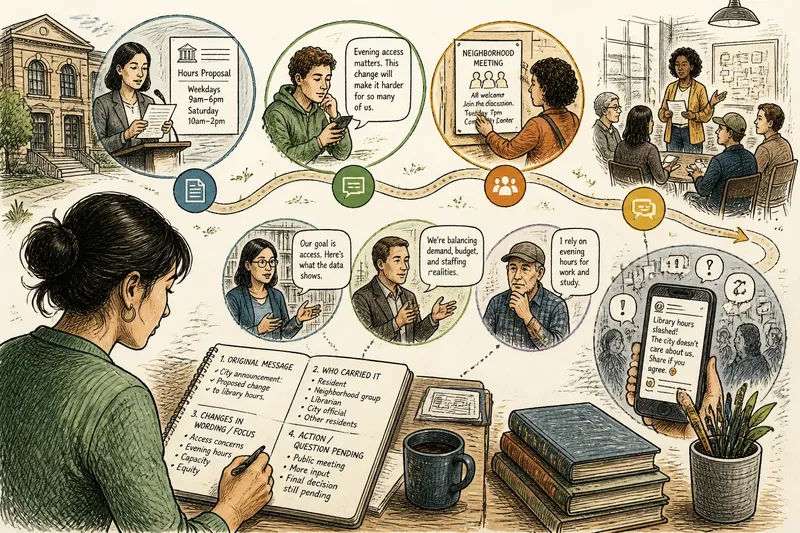
Say you see a city announcement about changing library hours, followed by a resident’s post describing reduced evening access and a neighborhood group’s call for a meeting. Write those events in order and compare the wording of the announcement with the resident’s account. The expected result is a clearer distinction between what the city proposed, what the resident experienced or anticipates, and what the group is asking people to do.
Notice the messengers
A message gains meaning from who shares it and where. A neighborhood association may bring residents together around a local concern; a librarian may explain operational details; a public official may describe the decision-making process. Each can contribute useful context, but none automatically speaks for every person affected.
Keep a small map of the voices that matter to the discussion. For each, note their connection to the issue and what they contribute. If someone’s role is unclear, record that uncertainty instead of assigning them authority based on a title, follower count, or confident tone.
- Check whether the original announcement is available; if it is, use its exact wording as the starting point, and if not, mark the account as incomplete.
- Check whether a speaker has direct involvement; if so, note what they can describe firsthand, and if not, avoid treating their account as direct experience.
- Check whether a group identifies whom it represents; if it does, attribute its position to that group, and if it does not, avoid presenting it as a community-wide view.
- Check whether a later post links to the source it summarizes; if it does, compare the summary with the source, and if it does not, keep the summary provisional.
- Check whether participants are responding to the same proposal; if they are, compare their reasons, and if they are not, separate the issues before judging the disagreement.
- Check whether people affected by the decision have a way to contribute; if they do, note how their input is gathered, and if they do not, identify whose perspective may be missing.
Not every person who shares a concern will use the same language or seek the same outcome. A public conversation can include residents asking for access, staff raising capacity concerns, and officials explaining constraints. Keeping those positions distinct makes disagreement easier to understand without flattening it into competing camps.
Follow the message shifts
As a discussion travels, a phrase may be shortened, a detail may disappear, or an interpretation may become more prominent than the original wording. These changes are not automatically deliberate. They can happen because a post is brief, a speaker emphasizes a different concern, or a new audience brings a different question.
Compare the source with the version being discussed. Look for what was quoted, what was left out, and whether the new version adds a claim about motive or impact. If the conversation depends on a short clip or excerpt, seek the surrounding words before drawing a firm conclusion.
It is not worth the effort to catalogue every repost or minor variation. Follow the versions that materially alter the issue, add a new group of participants, or prompt a response from someone with relevant experience. That keeps the record useful rather than turning it into an archive.
What changes as it spreads?
Why does a message change as people share it?
People select details that matter to them, and each new setting can make a different part of the message salient. Compare the shared version with the source before assuming the shift was intentional.
How can I tell who a group represents?
Look for the group’s stated membership, purpose, and method for gathering views. If those are unclear, describe its position as the group’s own rather than treating it as a consensus.
What should I do when a post lacks context?
Look for the original statement or the surrounding exchange and note what you cannot verify. If the missing context remains unavailable, keep conclusions about the speaker’s meaning tentative.
How do I know whether the discussion has reached a decision?
Check for a concrete action, such as a published decision, a scheduled meeting, or a stated next step. A large response or repeated slogan alone does not show that participants have agreed or that an institution has acted.
Keep a useful record
For a conversation you want to understand, keep a brief note with four entries: the original message, the people or groups who carried it, the main changes in its wording or focus, and the action or question still pending. Add a source beside each entry when one is available. This makes it easier to return later without relying on memory of the most vivid reply.
Suppose you are following a proposed change to library hours. Your starting inputs are the city’s announcement, a resident’s post about evening access, and a neighborhood group’s meeting notice. First, record the announcement’s stated proposal; next, note that the resident is concerned about access; then record that the group is calling for discussion, not necessarily claiming to represent every resident. The resulting account is that a proposal prompted an access concern and a meeting request, while the effect on other users and the city’s final decision remain open questions.
Use the search phrase “read a public conversation before taking a side” as a reminder to examine the route a message took, not merely its most forceful retelling. A careful reading can identify who contributed, what shifted, and which unanswered question deserves attention next.